Architectural Lighting
·
How Many Downlights Do I Need? Why Less Is Often More
Discover why fewer downlights often create better interiors. Learn how thoughtful lighting design delivers beautiful, functional spaces with less.

One of the most common questions we hear at Cobinlight is:
“How many downlights should I install?”
The answer surprises many homeowners.
In most cases, fewer than you think.
For years, homes were designed with ceilings filled with evenly spaced downlights, creating a grid of light across every room. While it may have seemed like the best way to brighten a space, modern lighting design has moved away from this approach.
Today, architects and interior designers understand that great lighting isn’t about quantity—it’s about purpose.
The Problem with Too Many Downlights
Installing too many downlights can actually work against a beautiful interior.
Over-lighting can make a room feel flat, clinical and lacking in atmosphere. It also creates unnecessary glare, increases energy consumption and often highlights imperfections in ceilings and finishes.
Perhaps most importantly, when every corner of a room is lit equally, there is no contrast, depth or visual interest.
The best interiors use light selectively.
Every Light Should Have a Purpose
Rather than asking, “How many downlights do I need?”, a better question is:
“What do I need each light to do?”
Each fitting should serve a specific function, whether that is:
Illuminating a kitchen worktop
Highlighting artwork
Washing light down a textured wall
Creating ambience in a living space
Providing circulation lighting through a hallway
If a light has no purpose, it probably doesn’t need to be there.
Layering Light Creates Better Spaces
Professional lighting design uses layers rather than relying solely on ceiling downlights.
These layers include:
Ambient Lighting
The general illumination that allows a room to function comfortably.
Task Lighting
Lighting for specific activities, such as cooking, reading or working.
Accent Lighting
Focused light that highlights artwork, architectural details, feature walls or furniture.
Decorative Lighting
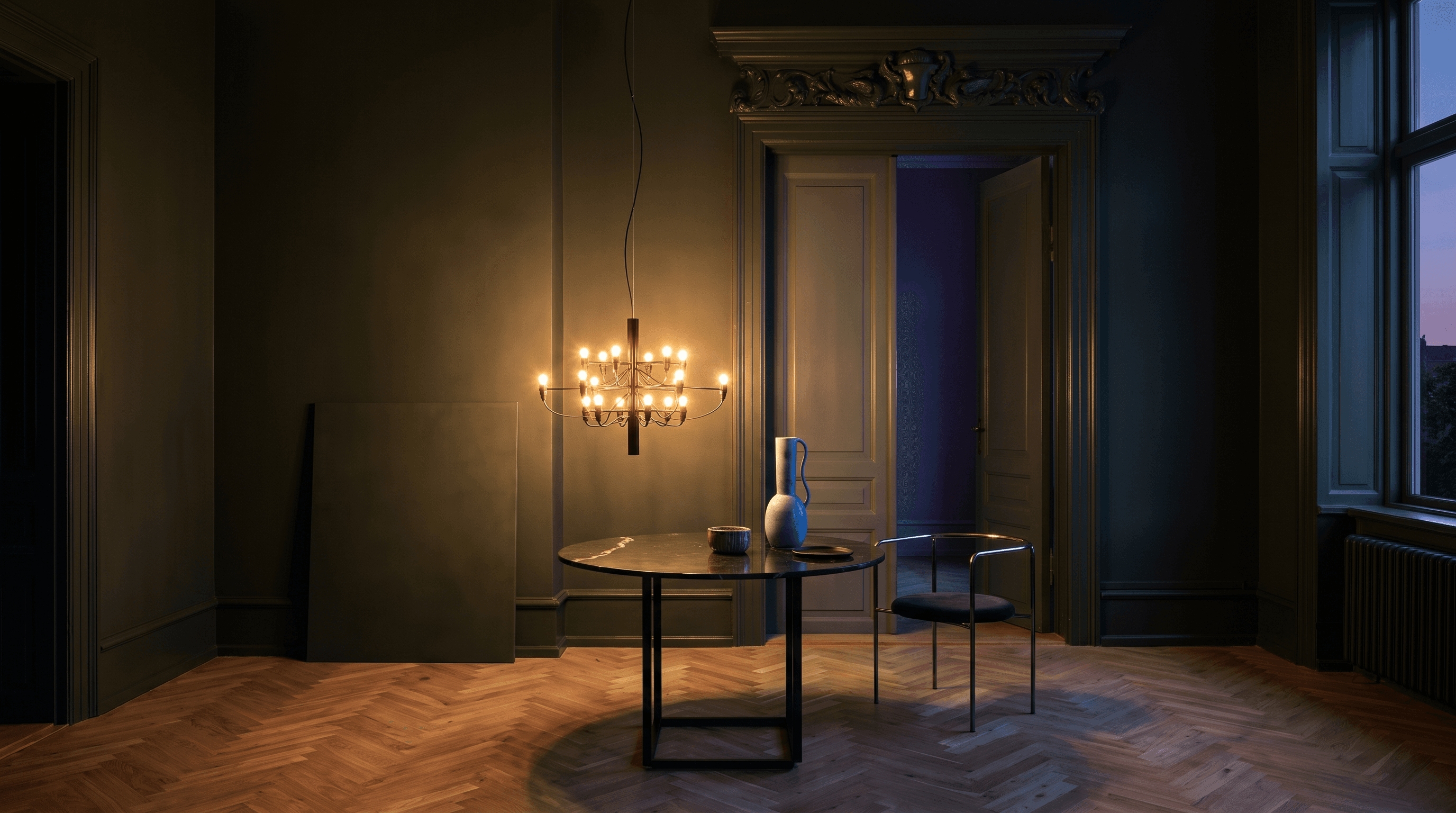
Pendant lights, wall lights and statement fixtures that become part of the interior design while also contributing light.
When these layers work together, far fewer downlights are required.
Spacing Matters More Than Quantity
Adding more downlights rarely improves a room.
Correct placement is far more important.
Poorly positioned fittings can create harsh shadows, uncomfortable glare or uneven lighting, while carefully positioned downlights can illuminate an entire space with surprisingly few fixtures.
Professional lighting design always considers:
Ceiling height
Beam angle
Room dimensions
Surface finishes
Furniture layout
Natural daylight
Intended use of the room
There is no universal spacing rule that works for every project.

Different Rooms Need Different Approaches
Every room serves a different purpose, so lighting should be designed accordingly.
A kitchen may require carefully positioned task lighting over preparation areas.
A living room benefits from softer pools of light that encourage relaxation.
Bedrooms are usually better with warm, layered lighting than rows of bright ceiling fittings.
Bathrooms need practical illumination around mirrors while still feeling calm and inviting.
The goal is always to create the right atmosphere—not simply achieve maximum brightness.
Why Luxury Homes Use Fewer Downlights
Look through the portfolio of almost any award-winning architectural home and you’ll notice something interesting.
The ceilings are remarkably clean.
Rather than filling every ceiling with dozens of fittings, designers use discreet downlights only where they are needed, allowing feature pendants, concealed LED lighting and carefully placed wall lighting to define the space.
The result feels elegant, considered and timeless.
It’s a philosophy of restraint.
Less clutter.
Less glare.
More impact.
Quality Over Quantity
Investing in fewer, higher-quality fittings almost always delivers a better result than installing a large number of cheaper alternatives.
Premium luminaires offer:
Better beam control
Superior colour rendering
Reduced glare
Longer lifespan
Greater visual comfort
A cleaner architectural appearance
Lighting should enhance a space, not dominate it.
Let the Architecture Shine
Great lighting isn’t noticed because there is a lot of it.
It’s noticed because it feels effortless.
At Cobinlight, we believe every luminaire should have a purpose. By carefully considering how a space will be used, we help create homes that feel warm, welcoming and beautifully balanced—without filling every ceiling with unnecessary downlights.
When it comes to lighting design, less really is more.